

Paycheck Budgeting: A Simple Plan for Every Payday
Most people do not run out of money because they spend too much in a month. They run out because the rent is due on the 1st, the car payment on the 5th, and payday does not arrive until the 7th. The month balances on paper and still falls apart in real life. That timing problem is exactly what paycheck budgeting fixes.Instead of one big monthly plan, you build a small plan for every paycheck: the money that lands, the bills due before the next one arrives, and what is left for everything else. It takes about thirty minutes to set up and five minutes on each payday to run.
Why a Monthly Budget Fails Biweekly Workers
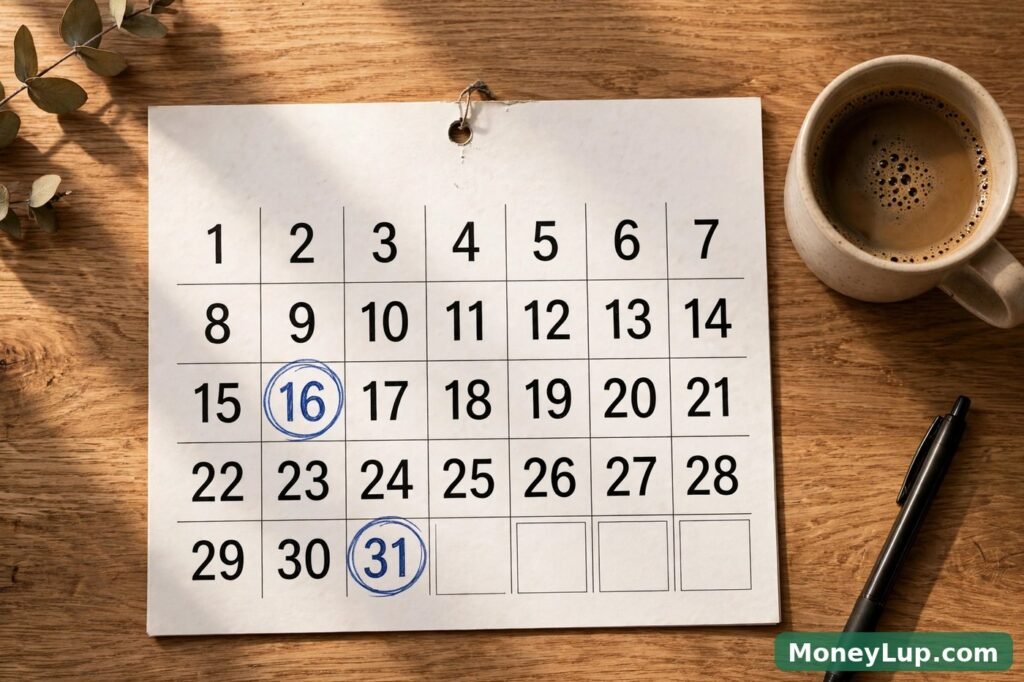
A monthly budget assumes money arrives once and bills leave evenly. For anyone paid every two weeks, neither is true. You get 26 paychecks a year, which means ten months have two paydays and two months have three. Meanwhile your bills land on fixed calendar dates that
ignore your pay schedule completely.
The result is a familiar pattern: the first week after payday feels comfortable, the second week gets tight, and the last few days before payday are a scramble — even in months where the total numbers worked out fine. Paycheck budgeting ends that cycle by matching money in to money out, one pay period at a time.
The 4-Step Payday Routine
Step 1 — Write down this paycheck’s take-home amount. Not your salary, not last month’s average — the exact amount hitting your account this Friday. If your hours vary, use the lowest recent paycheck as your planning number and treat anything above it as a bonus to savings later. Best for: everyone, but especially hourly workers whose checks move around.
Step 2 — List only the bills due before your next payday. Open your calendar and write down every bill with a due date between this payday and the next one: rent, utilities, car payment, insurance, phone, subscriptions, minimum card payments. Ignore everything due later — it belongs to a future paycheck’s plan. This is the step most budgets skip, and it is the step that stops the overdrafts.
Step 3 — Split what is left into three buckets. After bills, divide the remainder three ways: variable spending (groceries, gas, household), fun money, and savings. A simple starting split is 70% variable, 10% fun, 20% savings — adjust the percentages to your life, but keep all three buckets funded. A plan with no fun money lasts about as long as a diet with no food you like, and a plan with no savings line never builds a cushion.
Step 4 — Move the money the day you are paid. On payday, transfer the savings amount out first, then set aside the bill money — a separate checking account or a simple envelope system both work. What stays in your main account is your spending money for the next two weeks. If it is not in the account, you cannot accidentally spend it on Tuesday and discover the electric bill on Thursday.
A Full Worked Example: Dana, $1,900 Every Two Weeks
Dana is 27, works in customer support, and takes home $1,900 every two weeks — $3,800 in a typical two-paycheck month. Her rent is $1,150, due on the 1st, and most of her other bills cluster in the first half of the month. Under a monthly budget she was always broke by the 20th. Under paycheck budgeting, her two paychecks look like this.
Paycheck 1 (arrives the 1st Friday of the month):
| Rent | $1,150 |
| Electric bill | $95 |
| Phone | $65 |
| Groceries (2 weeks) | $220 |
| Gas | $90 |
| Fun money | $80 |
| Emergency fund | $200 |
| Total | $1,900 |
Paycheck 2 (arrives the 3rd Friday of the month):
| Car payment | $285 |
| Car insurance | $110 |
| Internet | $70 |
| Streaming subscriptions | $45 |
| Groceries (2 weeks) | $220 |
| Gas | $90 |
| Household + personal | $150 |
| Fun money | $80 |
| Emergency fund | $200 |
| Sinking fund (car repairs, gifts) | $150 |
| Buffer | $500 |
| Total | $1,900 |
Wait — that second paycheck adds up to $1,900 only if you count the $500 buffer, and that is the point. Paycheck 2 is lighter on bills, so Dana deliberately parks the surplus as a buffer instead of letting it evaporate. That buffer is what covers the months when a tire blows out, or when rent week and insurance week collide. Two paychecks a year, she also gets a third paycheck in the month — and her rule is simple: third paychecks go straight to the emergency fund. No decision, no debate.

The Third-Paycheck Trick
If you are paid biweekly, two months a year bring three paychecks instead of two. Most people absorb those extra checks into everyday spending without noticing. Treat them as windfalls instead: send the whole third paycheck to your emergency fund, or split it between savings and any debt you are paying down. Over a year, that is roughly $3,800 of extra progress for zero extra effort — the single easiest savings habit a biweekly worker has. Our Savings Goal Calculator can show you what those third paychecks add up to over a year.
Common Paycheck Budgeting Mistakes
Planning from your salary, not your take-home pay. Taxes, retirement contributions and insurance premiums come out before you see a dollar. Budget the number that lands, or every line after it is fiction.
Forgetting the bills that do not fall in this pay period. A bill due three days after your next payday belongs to the next paycheck — but only if you actually write it into that paycheck’s plan when the time comes. Keep a running list of all bills and due dates somewhere visible, and check it every payday.
Treating the light paycheck as a bonus. The paycheck with fewer bills is not extra spending money. It is the one that funds your buffer, your sinking funds, and your emergency fund. Spend it like a bonus and the heavy paycheck month will punish you for it.
Skipping the payday transfer. A plan you do not act on the day you are paid is a plan you will forget by Monday. The five-minute transfer on payday is the whole system working.
Paycheck Budgeting vs. Monthly Budgeting
Neither is “better” in the abstract — it depends on how you are paid. Monthly budgeting is simpler to see at a glance and works well for salaried workers paid once a month. Paycheck budgeting is better for biweekly and weekly pay, because it matches the rhythm money actually moves in your life. If you have tried a monthly budget and kept running dry before payday, the problem was probably timing, not willpower. Try the paycheck version for one month and compare. If you want the monthly view as well, our beginner’s guide to budgeting walks through a full monthly plan you can run alongside it.
Final Words
Paycheck budgeting is not a stricter budget. It is a budget that respects your calendar. Write down each paycheck, list only the bills due before the next one, split the rest three ways, and move the money on payday. Do that four or five times and something shifts: payday stops being a rescue and starts being a routine. The money already knows where it is going before the weekend starts.
FAQ
What if my paychecks are different every time? Budget on your lowest recent paycheck and treat anything above it as extra. When a bigger check arrives, send the difference to savings before you get used to spending it.
How do I handle bills that are due before my first paycheck of the month? That is the classic timing trap. Cover those bills from the previous paycheck’s buffer — which is exactly why the light paycheck builds a buffer in the first place. If you are starting from zero, your first month’s goal is simply to build a one-paycheck buffer.
Should I use cash envelopes or a separate bank account? Either works. Envelopes make spending visible; a separate account is harder to raid on impulse. Pick the one you will actually maintain — the best system is the one still running in month six.
What about months with three paychecks? Send the third paycheck to your emergency fund or a sinking fund. It is the easiest savings win available to biweekly workers, and it requires no sacrifice from your normal spending.
Can I combine paycheck budgeting with 50/30/20? Yes. Use 50/30/20 as your monthly target split, and paycheck budgeting as the weekly execution. Our 50/30/20 Budget Calculator gives you the monthly numbers; the payday routine makes sure the timing works.
Educational content only — not financial advice