
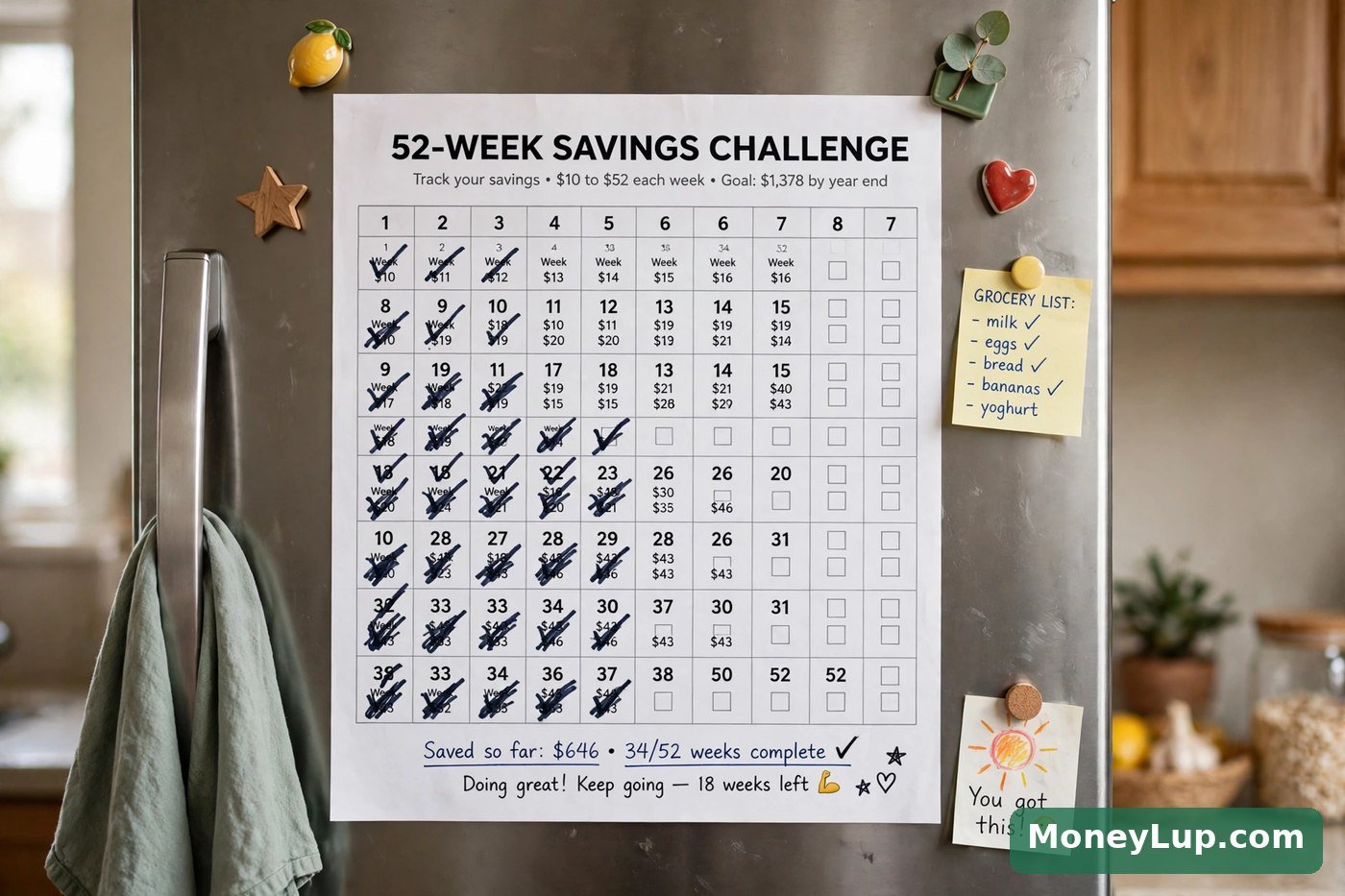
52-Week Money Challenge: Finish It This Time
The 52-week money challenge has a dirty secret: it’s designed to get hardest exactly when your wallet is weakest. Week 49 asks for $49, week 50 for $50, then $51 and $52 — over $200 of saving in December, the most expensive month of the year. That’s why most people quietly quit around week 40, with a few hundred dollars saved and a guilty feeling.
The challenge itself is sound — finish it and you have $1,378. The trick is choosing the version you can actually complete. This guide covers the classic challenge, why people quit, and the two fixed versions (reverse and flat) that fix the December problem, with a free printable tracker to stick on your fridge.
How the Classic Challenge Works
Simple rules: in week 1 you save $1, week 2 you save $2, and so on, adding a dollar each week until week 52’s $52. Small at the start, serious by the end:
| Milestone | That week’s amount | Total saved so far |
|---|---|---|
| Week 10 | $10 | $55 |
| Week 26 (halfway) | $26 | $351 |
| Week 40 | $40 | $820 |
| Week 52 | $52 | $1,378 |
The early weeks build the habit while it’s cheap. The problem isn’t the beginning — it’s the design of the end.
Why Most People Quit (It’s Not Willpower)
Look at the last stretch honestly. Weeks 49–52 demand $49 + $50 + $51 + $52 = $202 in four weeks, landing in the season of gifts, travel and celebrations. Meanwhile the challenge gave you no credit for the hard part — you’ve already saved over $1,100 by then.
Add two smaller traps: a single missed week creates a “catch-up debt” that feels impossible, and cash sitting in a drawer tends to get quietly re-spent. Every one of these is a design flaw, not a character flaw — and design flaws have design fixes.
Fix #1 — The Reverse Challenge
Save $52 in week 1, $51 in week 2, counting down to $1 in the final week. The total is identical — $1,378 — but the hard weeks happen in January, when motivation is highest and holiday spending is over. December’s final four weeks ask for just $10 total. Best for: anyone starting in January, or anyone who has quit the classic version before.

Fix #2 — The Flat Challenge
Save the same amount every week: $1,378 ÷ 52 ≈ $26.50 a week. No surprises, no December spike, and it automates beautifully — one weekly transfer and you’re done. Paid every two weeks instead? Save $53 per paycheck, 26 times: same $1,378. Best for: people with steady paychecks who want zero weekly thinking.
Fix #3 — The Flexible (Bingo) Version
Print the tracker, and each week pick any unused amount from $1–$52 that fits that week’s reality — $48 after a cheap week, $9 after an expensive one. Cross it off; every amount gets used exactly once. Best for: irregular incomes, freelancers, and anyone whose months are uneven.
Which Version Should You Pick?
| Version | Weekly pattern | Best for |
|---|---|---|
| Classic | $1 rising to $52 | People who need a gentle start |
| Reverse | $52 falling to $1 | January starters, past quitters |
| Flat | $26.50 every week | Steady paychecks, automation fans |
| Flexible | Any $1–$52, once each | Irregular income |

5 Rules That Get People to Week 52
- Save on payday, not “later.” Transfer the week’s amount the day money arrives. Waiting until the end of the week is how weeks get missed.
- Keep the tracker visible. Fridge door beats phone app for most people — a chart you see daily is a promise you keep daily. Download our free printable tracker (PDF) and check off each week as you go.
- Move the money out of reach. A separate savings account, not the drawer. If seeing a goal date helps, our Savings Goal Calculator shows exactly when $1,378 lands.
- Pre-forgive one bad week. Decide now: if a week goes wrong, you’ll split its amount across the next two weeks. One rule like this is the difference between a stumble and a quit.
- Pair it with a spending freeze. Many finishers run one no-spend week per month alongside the challenge — our No-Spend Challenge guide shows how to set that up without burning out.
Final Words
The 52-week challenge doesn’t fail people in week 1 — it fails them in December, by design. Pick the version whose hardest weeks land where your life can carry them, automate what you can, forgive the one bad week in advance, and let the tracker on the fridge do the daily reminding. $1,378 won’t change your life, but finishing will change what you believe about yourself with money — and that belief funds every goal after this one.
Educational content only — not financial advice.
FAQs
How much do you end up with in the 52-week challenge?
$1,378, whichever version you choose — classic, reverse, flat or flexible all add up to the same total.
What if I miss a week?
Split the missed amount across the next two weeks and continue. Quitting over one missed week is the most common way this challenge dies; the catch-up rule exists precisely to prevent it.
Should I keep the money in cash or in a bank account?
A separate savings account is safer and harder to “borrow” from. Cash in an envelope works for people who find physical money more motivating — just keep it somewhere you won’t casually dip into.
When is the best time to start?
Today, whatever week of the year it is. If you’re starting late in the year, choose the reverse version so the big amounts don’t collide with holiday spending.
Can I do the challenge with bigger amounts?
Yes — double every number ($2, $4, $6…) and the total doubles to $2,756. Only scale up if the classic version genuinely looks easy on your current budget.